Keyword research is one of the most important parts of search engine optimization (SEO). Whether you are starting a blog, launching a business website, or creating content for an existing website, choosing the right keywords can help your pages reach the right audience.
But if you are new to SEO, keyword research can seem complicated. What keywords should you target? How much search volume is enough? What does keyword difficulty mean? And how do you turn raw search queries into qualified customer inquiries?
This beginner-friendly guide explains how to do keyword research step by step, including how to find keyword ideas, understand search intent, evaluate competition, and choose the right keywords for your content. When paired with a disciplined SEO strategy for a new website, keyword research becomes your competitive blueprint for sustainable organic visibility.

What Is Keyword Research?
Keyword research is the process of finding and analyzing the words and phrases people enter into search engines such as Google when looking for information, products, or services.
For example, someone interested in SEO might search for:
- How to do keyword research
- Keyword research for beginners
- Best keyword research tools
- How to find keywords for SEO
- Free keyword research tools
These phrases are known as keywords or search queries.
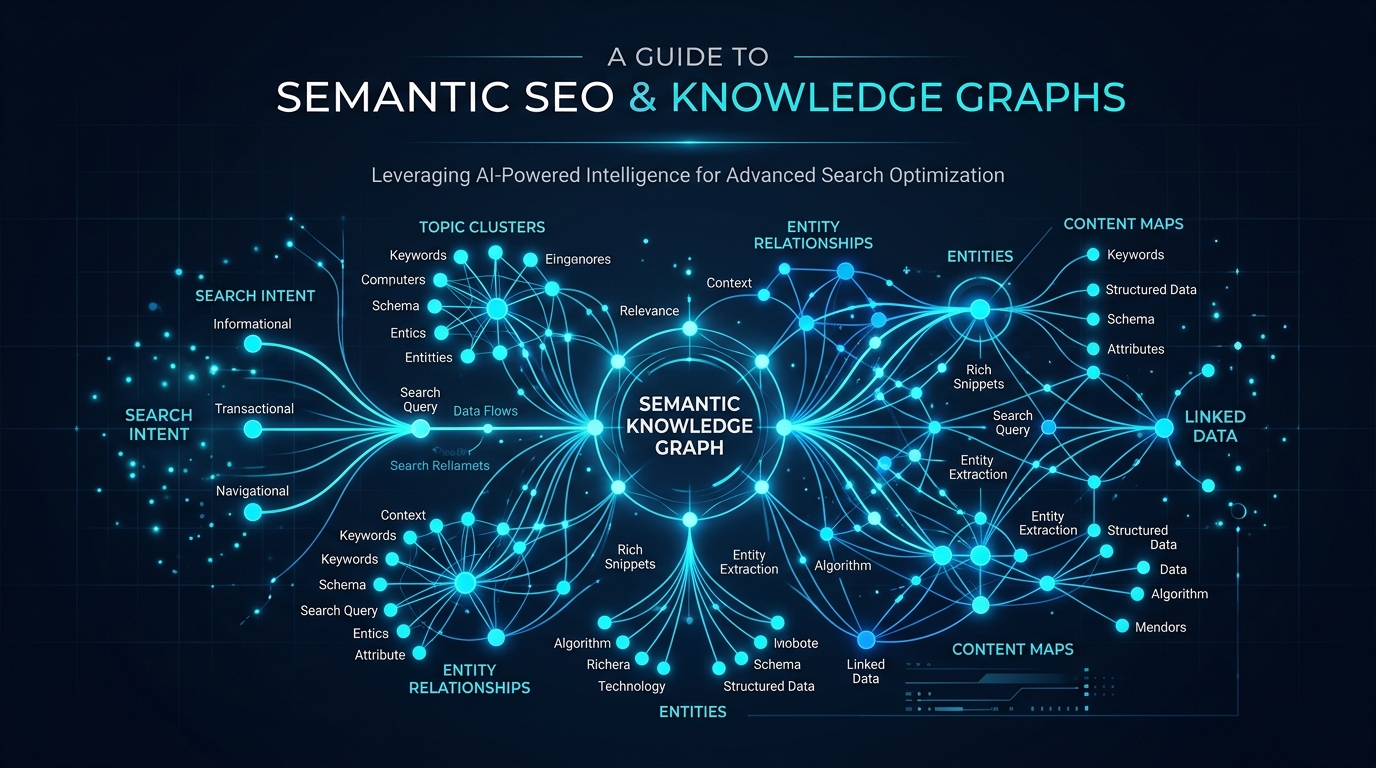
The goal of keyword research is not simply to find keywords with high search volume. You need to identify keywords that are relevant to your website, match your audience's search intent, and have a realistic opportunity to rank for. In modern search marketing, understanding entities and user problems is just as crucial as tracking search phrases (learn more in our guide on Semantic SEO and Entity Optimization).
Why Is Keyword Research Important for SEO?
Keyword research helps you understand what your target audience is searching for online.
It can help you:
- Find topics your audience genuinely cares about
- Create content based on real search demand rather than guesswork
- Improve your website's organic visibility across Google and AI-powered search engines
- Attract more relevant, high-intent visitors who are ready to convert
- Understand your competitors and discover their content gaps
- Discover low-competition opportunities that established sites overlook
- Build an effective, long-term SEO content strategy
Core Rule: Without keyword research, you may spend hours creating content that very few people search for. The best keyword is one that connects what people are searching for with what your website can genuinely provide.
How to Do Keyword Research Step by Step
To make keyword research manageable, follow this step-by-step framework:
1. Start With Your Main Topic
First, choose a broad topic related to your website, business, or industry. These broad themes are often referred to as “seed topics” or “head topics.”
For example, if you run a digital marketing website, your main topics might include:
- Search engine optimization (SEO)
- Content marketing
- Social media marketing
- Email marketing
- Google Ads & Performance PPC
Let's say your chosen topic is SEO.
You can then break it into smaller subtopics such as keyword research, on-page SEO, technical SEO, link building, and regional and international search like SEO in Calicut, Kochi, and Dubai. Structuring your topics early lays the groundwork for powerful topic clusters and topical authority.
2. Create a List of Keyword Ideas
Start by thinking about what your potential customers or readers might search for when exploring your niche.
For the topic of keyword research, possible ideas include:
- keyword research
- keyword research for beginners
- how to find keywords
- SEO keyword research
- keyword research tools
- long-tail keywords
- keyword difficulty
- keyword search volume
You can also use Google's built-in search suggestions (Autocomplete), “People Also Ask” snippets, and “Related Searches” at the bottom of the SERP to discover additional ideas without spending a penny.
Dedicated tools such as Google Keyword Planner, Semrush, Ahrefs, and Moz can expand your initial seed list into hundreds of keyword variations.
3. Understand Search Intent
Search intent refers to the underlying motivation behind a person's search. Why did they type that phrase into Google?
Understanding search intent is essential because Google's primary goal is to satisfy the user with the most helpful, direct answer possible. One proven technique to satisfy intent immediately is using the BLUF (Bottom Line Up Front) content approach, answering the primary question before diving into detailed explanations.
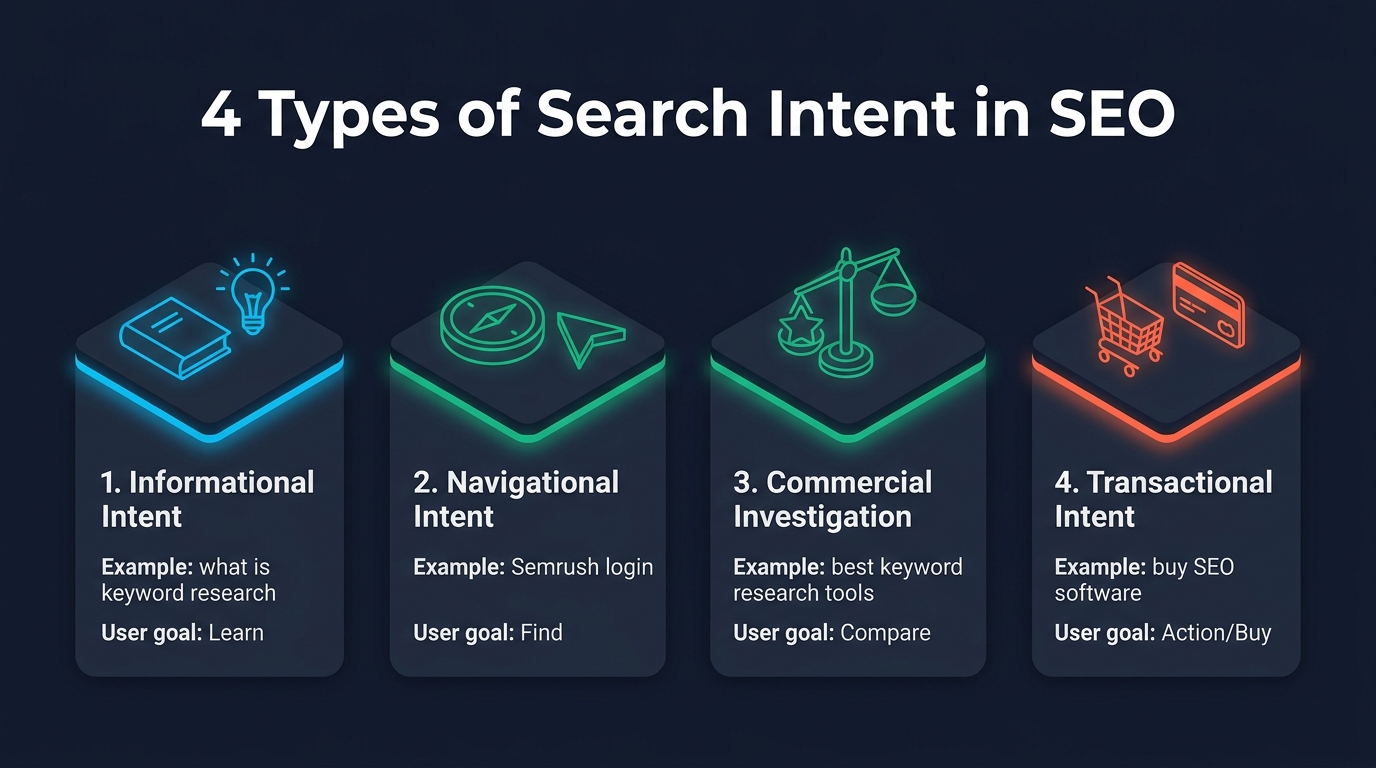
Search intent is typically divided into four primary categories:
| Search Intent | User Motivation | Example Query | Ideal Content Type |
|---|---|---|---|
| Informational | The user wants to learn something or solve a problem. | “What is keyword research?” | How-to guides, educational blog posts, tutorials |
| Navigational | The user wants to navigate to a specific website or brand. | “Semrush login” | Brand homepage, login portal, official resource |
| Commercial Investigation | The user is comparing options, tools, or services before deciding. | “Best keyword research tools” | Comparison lists, tool reviews, buyer guides |
| Transactional | The user is prepared to make a purchase or hire a specialist. | “Hire SEO consultant in Kerala” | Product pages, service landing pages, contact forms |
Before targeting a keyword, search for it on Google and look at the first page of results. If all top results are detailed tutorials, Google expects informational content. If all results are product pages, an informational blog will struggle to rank.
4. Check Search Volume
Search volume estimates the average number of times a keyword is searched per month.
A keyword with high search volume can potentially bring significant traffic. However, high-volume keywords often come with fierce competition from high-authority legacy publications.
For example, a broad keyword such as “SEO” may have millions of monthly searches, but a brand-new website has virtually zero chance of ranking for it on page one.
A more specific phrase such as “keyword research for beginners” may have lower search volume, but it delivers hyper-relevant visitors who are deeply engaged with your topic.
Never choose keywords based on search volume alone. Volume without intent alignment produces vanity traffic that rarely leads to meaningful business outcomes.
5. Analyze Keyword Difficulty
Keyword difficulty (often abbreviated as KD or Competition Index) estimates how challenging it is to rank on Google's first page for a specific query.
Highly competitive keywords (KD 70+) are typically dominated by multi-million-dollar domains with thousands of referring backlinks and established topical authority.
If your website is new or building domain authority, prioritize lower-difficulty keywords (KD < 30). For detailed advice on structuring a new domain for search engines, explore our guide on building an SEO strategy for a new website.
6. Look for Long-Tail Keywords
Long-tail keywords are longer, highly specific search queries (usually 3 to 5+ words). While each individual long-tail query has moderate or low search volume, collectively they make up more than 70% of all searches conducted on Google.
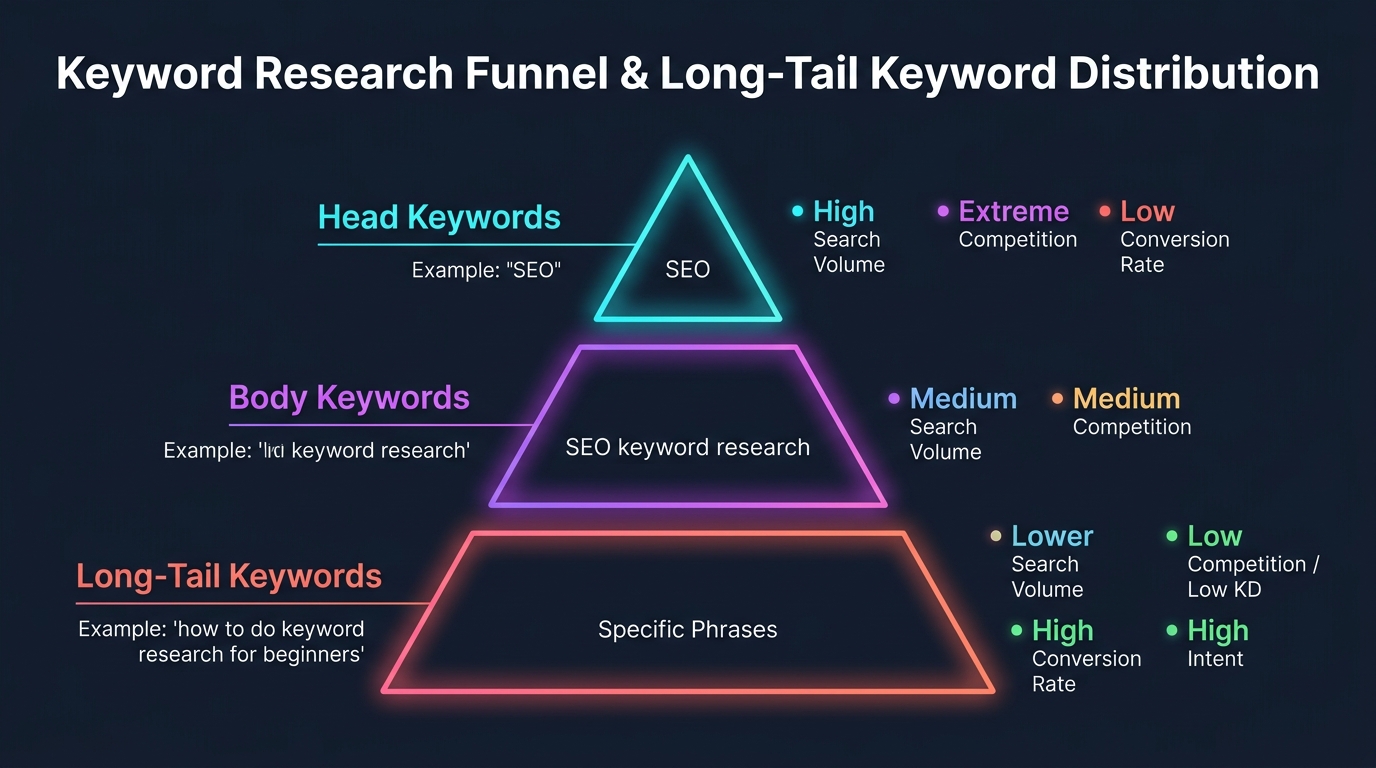
Consider the progression from broad terms to long-tail phrases:
- Broad Head Term: SEO (Massive search volume, impossible competition, vague intent)
- More Specific Body Term: SEO keyword research (Moderate volume, medium competition)
- Long-Tail Golden Phrase: How to do keyword research for beginners (Achievable competition, clear learning intent, high engagement)
Other practical long-tail examples include:
- how to do keyword research for a new website
- best free keyword research tools for beginners
- how to find low competition keywords for a blog
- how to choose keywords for local business SEO
For beginners, long-tail keywords are the fastest and most reliable path to generating organic impressions and landing your first paying clients. In our Medline Academy SEO case study, targeting specific, intent-focused queries drove over 2,220 organic WhatsApp inquiries with a 28x increase in average session duration.
7. Analyze Your Competitors
Competitor research can uncover lucrative keyword opportunities that your own brainstorming missed.
Search your primary target keyword on Google and examine the websites occupying positions 1 through 5. Ask yourself:
- What subtopics do they cover in their H2 and H3 headings?
- How is their content structured (lists, tables, screenshots)?
- What questions do they answer that you could answer more clearly?
- What related entities and semantic terms do they mention?
- How strong is their backlink profile compared to yours?
- Does Google show special SERP features like Featured Snippets, Video Carousels, or AI Overviews?
You don't need to copy competitors. Instead, identify where their content falls short, then create something more practical, up to date, and complete.
8. Choose the Right Keywords
After compiling a comprehensive list of ideas, create a focused shortlist. Every keyword you select should meet five critical criteria:
- Relevance: Does this search query directly relate to your core products, services, or expertise?
- Search Intent Alignment: Can you create the exact type of content the searcher expects?
- Realistic Difficulty: Does your website have sufficient domain authority to compete?
- Business Value: Does ranking for this keyword help you generate email subscribers, consultations, or direct sales?
- Topical Completeness: Does this keyword strengthen your overall topic cluster?
For example, if you are writing a beginner guide, “keyword research for beginners” is vastly more targeted and achievable than simply targeting “SEO.”
Best Keyword Research Tools for Beginners
You don't need expensive enterprise software suites to get started. Here are the top tools beginners can leverage:
| Tool Name | Pricing Model | Best For | Standout Advantage |
|---|---|---|---|
| Google Keyword Planner | 100% Free (Google Ads account required) | Seed ideas and commercial bid values | Direct search volume ranges straight from Google's ad database. |
| Semrush | Freemium (10 free searches/day) / Paid | Competitive keyword gap analysis & search intent filters | Instant intent categorization (I, N, C, T) and keyword difficulty scoring. |
| Ahrefs | Free Webmaster Tools / Paid | Backlink difficulty estimation and SERP analysis | Shows estimated clicks per search and parent topic grouping. |
| Moz Keyword Explorer | Freemium (10 queries/month) / Paid | Beginner-friendly difficulty scores & organic CTR | Simple interface that is intuitive for SEO newcomers. |
| Google Search Console | 100% Free | Existing website performance | Reveals real queries your site already ranks for on positions 10–30. |
When starting out, you do not need to subscribe to every tool. Pick one free or freemium tool, learn how to extract keyword difficulty and intent, and focus on producing exceptional content.
Common Keyword Research Mistakes to Avoid
Even seasoned marketers stumble into avoidable keyword traps. Keep these pitfalls in mind:
1. Targeting Only High-Volume Keywords
High search volume does not guarantee high-value traffic. Chasing terms with 50,000 monthly searches usually results in zero traffic for newer domains, whereas five targeted long-tail keywords with 200 searches each can generate reliable, qualified leads every month.
2. Ignoring Search Intent
If someone searches for a software login and your page is an educational essay, users will bounce immediately. Always search the query on Google first and analyze the ranking formats before writing.
3. Using Too Many Keywords (Keyword Stuffing)
Repeating your exact target keyword in every single sentence damages readability and violates Google's helpful content guidelines. Write naturally for human beings, incorporate semantic variations, and optimize using modern on-page SEO principles.
4. Choosing Irrelevant Keywords
A keyword with high volume is useless if the visitors it attracts have no interest in your services. Always align keywords with your core business offerings.
5. Forgetting About Your Human Audience
SEO algorithms are built to measure user satisfaction. If your article satisfies the user's problem better than any other page on the web, search engines and AI answer engines will reward it with lasting visibility.
How to Create a Structured Keyword Strategy
Once you have gathered a list of target keywords, don't scatter them across random blog posts. Group your keywords into organized topic clusters centered around pillar subjects:
| Pillar Hub | Supporting Long-Tail Keyword Cluster | Target Service / Resource Link |
|---|---|---|
| Keyword Research | • keyword research for beginners • how to find long-tail keywords • keyword research tools comparison • search intent optimization |
Topic Clustering Blueprint |
| On-Page SEO | • on-page SEO checklist • title tag best practices • meta description length • H1 heading optimization |
On-Page SEO Services |
| Technical SEO | • technical SEO basics • website crawlability checklist • XML sitemap best practices • Core Web Vitals optimization |
Technical SEO Services |
| Local SEO | • local SEO for small businesses • Google Business Profile tips • local map pack ranking factors • regional keywords in Kerala |
Google Business Profile Guide |
This organized structure helps search engine crawlers understand the depth of your domain, avoids keyword cannibalization, and distributes link equity efficiently across your pages.
Frequently Asked Questions
What is the easiest way to do keyword research for free?
The easiest free method is using Google Search itself. Type your seed topic into the search bar to inspect Autocomplete suggestions, study the “People Also Ask” box, and review “Related Searches” at the bottom of the page. You can also use free tools like Google Keyword Planner and Google Search Console to monitor real search impressions.
How many keywords should a beginner target per page?
Generally, focus on one primary keyword per page (e.g., “keyword research for beginners”) along with 3 to 5 closely related secondary or semantic keywords (such as “how to do keyword research step by step” and “search intent for SEO”). Avoid trying to optimize a single page for dozens of unrelated topics.
What is a good keyword difficulty score for a new website?
For a new website or a domain with minimal backlinks, aim for keywords with a Keyword Difficulty (KD) score under 30 (or labeled “Easy / Very Easy” in tools like Semrush or Ahrefs). As your topical authority and backlinks grow, you can gradually target more competitive terms.
How long does it take to rank for long-tail keywords?
For low-competition long-tail queries, a well-optimized, comprehensive article on an indexed website can begin appearing on the first page of Google within 4 to 8 weeks. Highly competitive broad keywords typically take 4 to 6+ months of consistent technical health and backlink growth.
How does keyword research help businesses in Kerala?
For businesses in Kerala, keyword research uncovers high-intent local queries such as SEO Expert in Calicut, SEO Services in Kochi, or international expansion queries in the Dubai and UAE markets. Targeting these specific localized phrases allows businesses to capture qualified inquiries from customers who are ready to buy.
Final Thoughts
Keyword research is the foundation of a successful SEO content strategy. You don't need to be an SEO veteran or have an expensive software stack to get started.
Begin by understanding your audience, brainstorming relevant seed ideas, confirming search intent, evaluating search volume and competition, and identifying realistic long-tail opportunities.
Most importantly, remember that search engines are evolving. The goal is no longer just ranking for a single phrase—it's about creating comprehensive, helpful resources that connect what people are searching for with what your website can genuinely provide.
If you are launching a new website or looking to scale your organic search traffic, partnering with an experienced SEO Expert in Kerala can help you build a personalized, data-driven keyword roadmap. You can also explore our flagship Ultimate Guide to SEO in Kerala, review credentials on the Juwaid KV author profile, or contact Juwaid KV today for a free SEO strategy consultation.