Search engine optimization in Kerala is experiencing its most consequential technological shift since the launch of Google Maps over two decades ago. For years, businesses in commercial epicenters like Kochi and Calicut (Kozhikode) measured digital success solely by whether they occupied the classic “top 3 blue links” on desktop and mobile SERPs.
Today, that traditional paradigm has fractured. With the aggressive rollout of Google AI Overviews (AIO), ChatGPT Search, Perplexity AI, and Microsoft Copilot, users are no longer clicking through five different websites to find a business. Instead, generative artificial intelligence synthesizes answers directly on the search screen, recommending two or three vetted brands as authoritative solutions.
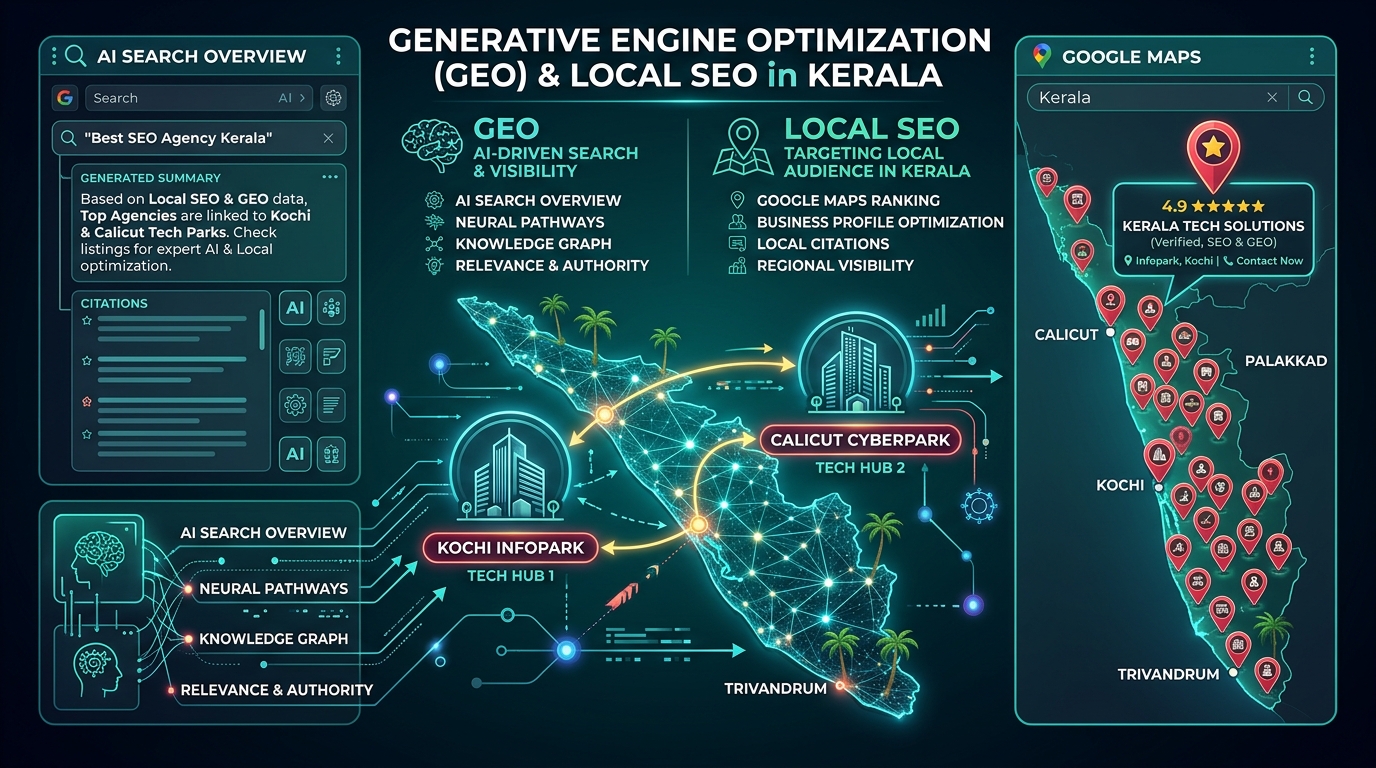
To survive and dominate this new search paradigm, regional brands must master Generative Engine Optimization (GEO) alongside foundational Local SEO. Whether you are scaling an IT enterprise at Cyberpark Kozhikode, managing a clinic in Ernakulam, or operating an export startup at Infopark Kochi, this guide provides an actionable, data-driven blueprint for winning both Google Map Packs and generative AI citations.
Bottom Line Up Front (BLUF):
Generative Engine Optimization (GEO) does not replace Local SEO—it expands it. Traditional Local SEO secures placement in Google's Local 3-Pack via NAP consistency, distance, and reviews. GEO convinces Large Language Models (LLMs) that your business is a trustworthy regional entity worth citing in synthesized answers. To rank across both, businesses in Kerala must combine verified Google Business Profiles with structured semantic schema, authoritative local citations, and direct conversational answer architecture.
What Is Generative Engine Optimization (GEO)?
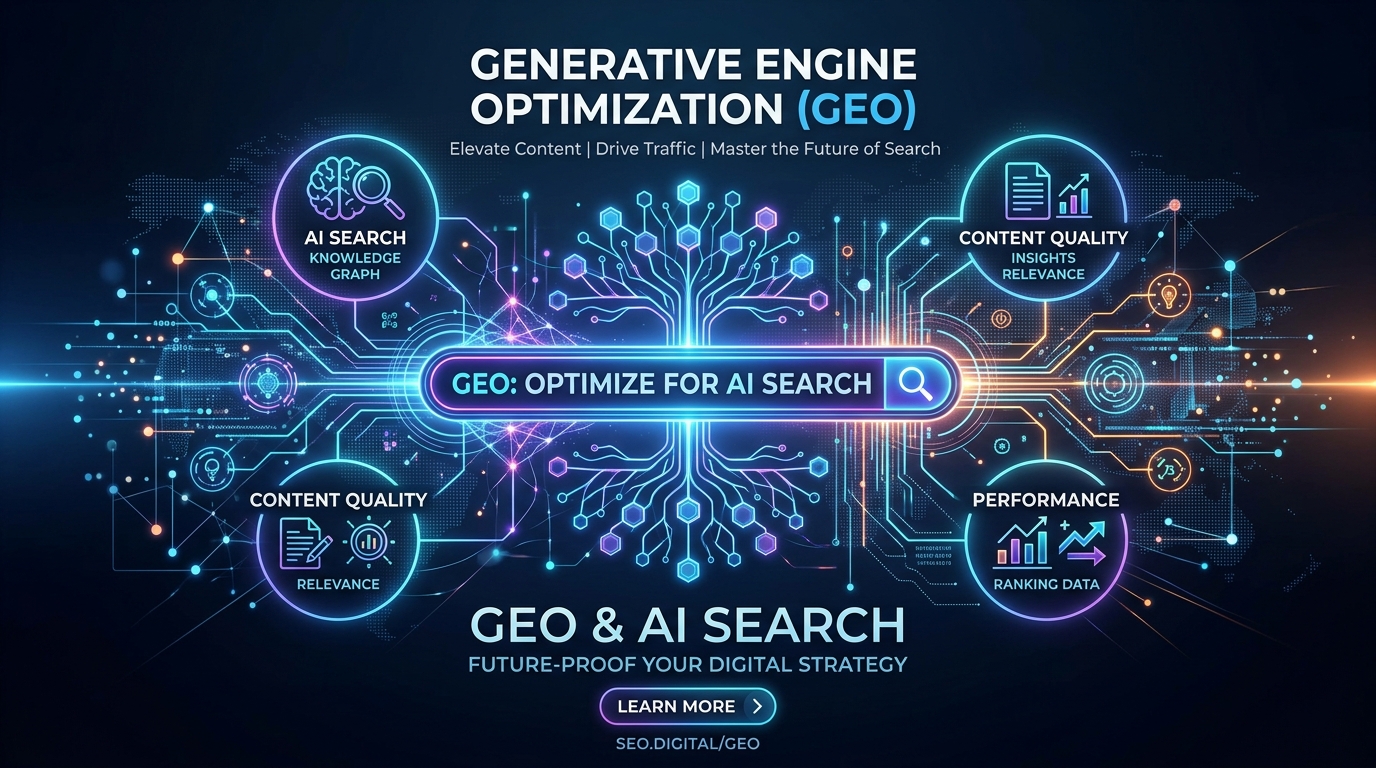
Generative Engine Optimization (GEO) is the systematic practice of optimizing your website, brand entities, and digital footprint so that artificial intelligence search engines and Large Language Models (LLMs) understand, cite, and recommend your business in their synthesized answers.
Unlike traditional search engines that crawl web pages to index text strings and rank URLs based on keyword density and PageRank, generative search engines operate as reasoning and synthesis engines. They evaluate vast knowledge graphs, multi-source citations, user sentiment, and topical depth to assemble direct answers to complex, conversational user queries.
When a prospective customer in Kerala asks an AI assistant:
- “Which IT support and cloud consulting firm in Kochi Infopark has the best enterprise track record?”
- “Who is the top-rated local SEO consultant in Calicut for healthcare practices?”
- “Compare the best B2B digital marketing agencies in Kerala with proven international client portfolios.”
The AI model does not return a list of ten blue links. It evaluates entity relationships, extracts factual data points from authoritative sources, and generates a structured summary. If your business is properly optimized for GEO, your brand becomes the explicitly cited source inside that summary. If not, your company is completely invisible to high-intent decision-makers.
For a foundational deep dive into how AI models parse knowledge, explore our comprehensive guide on Generative Engine Optimization (GEO) and our national analysis of AI search ranking across India.
Why Kerala's Commercial Ecosystem Demands GEO in 2026
Kerala represents one of India's most digitally connected, mobile-first consumer economies. With smartphone penetration exceeding 82% and an exceptionally literate, tech-forward population, search behaviors in Kerala evolve much faster than in conventional markets.
Three primary factors are accelerating the need for GEO across Kerala's business landscape:
1. Zero-Click Search Dominance on Mobile
More than 70% of local search queries in Kerala now resolve without a single click to an external website. Google AI Overviews and Google Business Profile widgets answer the searcher's question directly on the search engine results page (SERP). If your content only aims for position #3 in traditional organic links, you are fighting for traffic from a user who has already received their answer higher up on the screen.
2. The Surge of Conversational and Voice Search
Voice searches in both conversational English and Manglish (Malayalam-English hybrid queries) are expanding across Tier-1 and Tier-2 Kerala cities. Consumers don't search for robotic phrases like “dentist Calicut clinic”; they ask, “Which dental clinic near Mavoor Road is open on Sunday evening for emergency tooth extraction?” Generative AI thrives on answering these multi-attribute, conversational queries.
3. Cross-Border & Diaspora Commercial Intent
A substantial portion of high-value commerce in Kerala is driven by non-resident Keralites (NRKs) living in the GCC, Europe, and North America. NRKs researching real estate investments in Kochi, healthcare procedures in Calicut, or digital marketing agencies in Kerala frequently use AI search assistants (like ChatGPT and Perplexity) to compare options before contacting businesses. GEO ensures your brand is positioned as the authoritative market leader during this international evaluation process.
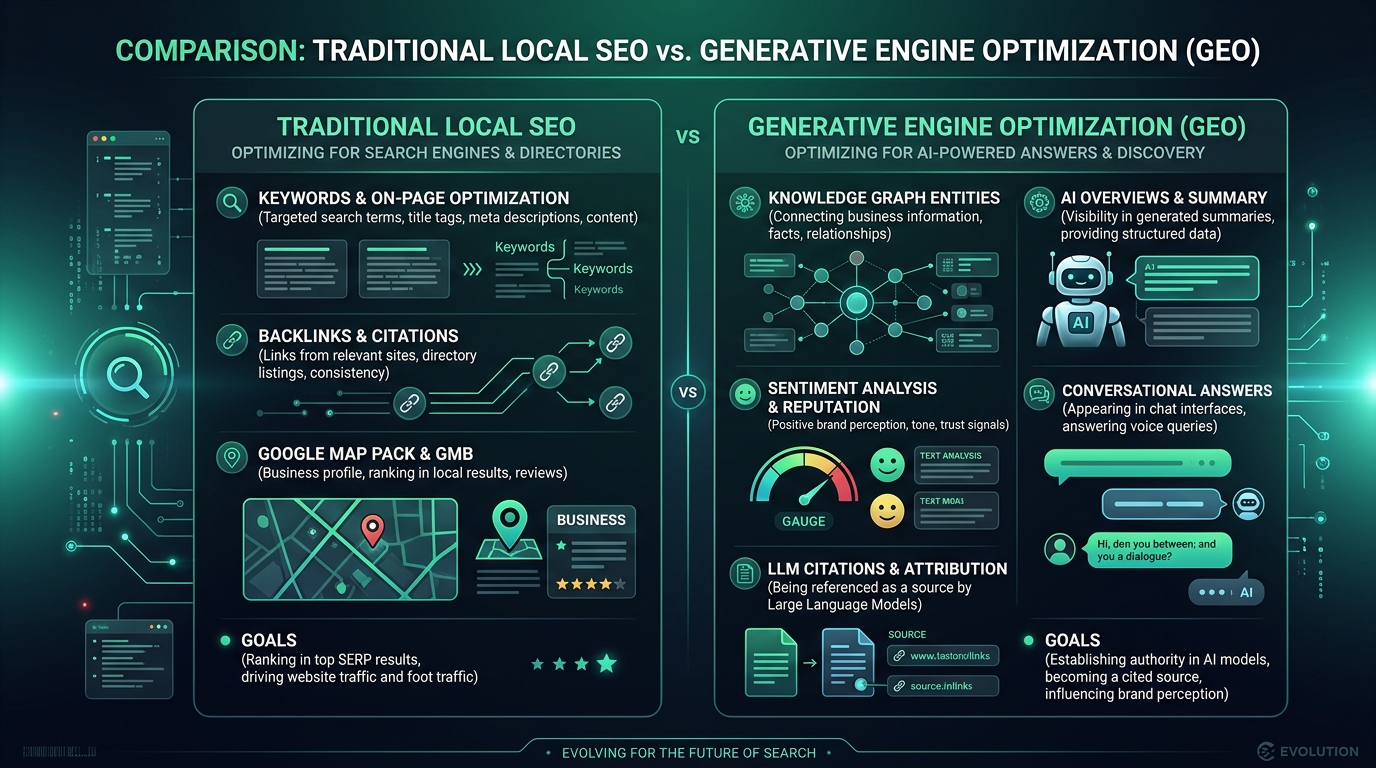
Traditional Local SEO vs. Generative Engine Optimization (GEO)
Many business owners mistakenly believe that GEO renders classic Local SEO in Kerala obsolete. In reality, GEO is an evolutionary layer built on top of strong local search foundations.
The table below highlights the crucial differences between traditional Local SEO and modern Generative Engine Optimization:
| Dimension | Traditional Local SEO | Generative Engine Optimization (GEO) |
|---|---|---|
| Primary Discovery Target | Google Local 3-Pack, Google Maps, Organic Blue Links. | Google AI Overviews, Perplexity Answers, ChatGPT Search, Copilot. |
| Search Query Type | Short-tail, keyword-driven (e.g., “SEO expert in Kochi”). | Conversational, multi-layered (e.g., “Find an SEO specialist in Kochi experienced in D2C e-commerce with verified client case studies”). |
| Ranking Signals | NAP consistency, physical distance, Google Business reviews, keyword density in H1/H2 tags. | Knowledge graph entity authority, cross-platform citation consensus, sentiment analysis, BLUF content structure. |
| Technical Enablers | XML sitemaps, basic LocalBusiness schema, page load speed, meta tags. | Nested JSON-LD entity schema (Wikidata/SameAs), llms.txt files, Markdown semantic clarity, high factual information density. |
| Content Formatting | Keyword-optimized paragraphs, landing page sales copy, standard blog posts. | Direct Q&A blocks, tabular comparisons, statistical data points, actionable checklists that LLMs can cleanly parse. |
| Success Metric | SERP rankings, organic click-throughs, direct phone call button clicks. | LLM citation rate, brand inclusion in AI recommendations, high-intent qualified conversion value. |
Winning in Calicut (Kozhikode): Local Search Dynamics for 2026
Calicut is Northern Kerala's commercial capital. From historical spice and timber trading along Sweet Meat Street (S.M. Street) to modern SaaS startups in Govt. Cyberpark and UL Cyberpark, Calicut combines deep-rooted local commerce with aggressive technological expansion.
If you run a business targeting Malabar customers, your search strategy must address distinct regional behaviors:
1. High-Density Micro-Locations
Searchers in Kozhikode frequently specify micro-neighborhoods in their queries. For example, queries targeting Mavoor Road, Thondayad Junction, Palayam, Nadakkavu, or Pottammal carry significantly higher commercial intent than broad terms like “services in Calicut.” AI models recognize these geographical boundaries when evaluating entity proximity.
2. The Healthcare and Medical Tourism Hub
Calicut is renowned across South India and the Middle East for advanced healthcare, anchored by institutions like Aster MIMS, Baby Memorial Hospital, and specialized clinics. Patients searching for medical services use multi-part questions to evaluate specialist qualifications and hospital accreditations. Local healthcare providers must optimize their entity profiles with specific Doctor/MedicalBusiness schema and verified patient outcomes.
3. IT & SaaS Emerging Ecosystem
With companies operating out of Cyberpark, Calicut has become a hub for web development, enterprise software, and digital marketing agencies. If you are an IT or service provider, working with an experienced SEO Expert in Calicut enables your business to build localized authority while simultaneously ranking for high-value client acquisition queries across Kerala and the GCC.
Calicut Pro-Tip: To rank in AI Overviews for Calicut queries, your website must clearly define your relationship with regional landmarks (e.g., ‘Located 500m from Thondayad Bypass Junction, Calicut’). Generative models cross-reference these physical anchors across OpenStreetMap, Google Maps, and local news citations.
Winning in Kochi (Cochin): The Tech, Tourism & B2B Battleground
Kochi is Kerala's undisputed industrial and financial powerhouse. Spanning the software corridors of Infopark Kakkanad, the corporate towers along M.G. Road, the retail destinations of Edappally and Lulu Mall, and the lifestyle hubs in Panampilly Nagar, Kochi represents the most competitive digital marketplace in the state.
Winning search visibility in Kochi requires an advanced, multi-layered approach:
1. Extreme B2B & Infopark Competition
Over 500 technology, fintech, and IT consulting enterprises operate within Infopark Phase 1 & Phase 2 and SmartCity Kochi. When enterprise clients search for tech vendors or specialized consultants, they turn to generative AI for comparative shortlists. B2B firms must establish deep topical authority through whitepapers, case studies, and industry citations. Businesses seeking to outrank competitive technology agencies can leverage dedicated SEO services in Kochi to structure their entity footprint.
2. High-Ticket Real Estate & Hospitality
Kochi's real estate developers (along Marine Drive, Kadavanthra, and Aluva) and luxury hospitality operators (in Fort Kochi and Kumbalangi) depend heavily on non-local inquiries from NRI investors and international tourists. Generative models evaluate sentiment, image quality, verified customer reviews, and amenities data before generating recommendations. Simple keyword stuffing on property pages will not trigger AI recommendations.
3. Hyper-Local Sub-Market Segmentation
Kochi is not a single contiguous search market; it is an archipelago of specialized districts. A business in Kakkanad targets tech professionals; a boutique in Panampilly Nagar targets affluent local consumers; an export firm in Willingdon Island targets global supply chain partners. Your localized pages must reflect these exact regional contexts with granular schema and localized copy.
The 6-Pillar GEO & Local SEO Action Plan for Kerala Brands
To establish durable organic visibility that captures both Google's local 3-pack and AI-generated overviews, follow this proven 6-pillar framework:
Pillar 1: Google Business Profile (GBP) & Multi-Platform Verification
Your Google Business Profile remains the foundational source of truth for both traditional Google Maps and Google AI Overviews. However, generative AI models also cross-reference Apple Maps, Bing Places, Justdial, Sulekha, and industry-specific directories to establish factual consensus.
- Flawless NAP Consistency: Ensure Name, Address, and Phone Number match character-for-character across every online citation.
- Specific Category Selection: Choose the most precise primary category (e.g., “Internet Marketing Service” rather than generic “Corporate Office”).
- Geo-Tagged Photography: Upload authentic, high-resolution photos of your physical office, team, and signage in Kochi or Calicut with embedded geographical metadata.
- Continuous Q&A Management: Populate your GBP Q&A section with common customer questions and comprehensive, authoritative answers.
Pillar 2: Advanced Semantic Schema Markup (JSON-LD)
Generative search engines rely on structured data to parse facts without ambiguity. A basic organization tag is no longer enough. Your website must incorporate nested, rich JSON-LD schema:
LocalBusinessor specific subtype (e.g.,ProfessionalService,MedicalBusiness) with complete geographic coordinates (geo: latitude and longitude).areaServedschema explicitly defining target cities: Kochi, Calicut, Trivandrum, and Kerala.sameAsarrays linking to verified Wikidata entries, Wikipedia pages, LinkedIn company profiles, and authoritative local business directories.FAQPageschema with clear, factual question-and-answer pairs matching real search queries. Learn how semantic schema creates interconnected entity graphs in our Semantic SEO and Entity Optimization Guide.
Pillar 3: The BLUF Content Architecture
Large Language Models are designed to reward direct, authoritative answers. Adopting the Bottom Line Up Front (BLUF) content structure ensures your web pages get extracted into AI Overviews.
- Place a concise, 2-3 sentence summary immediately following every major H2 heading.
- Answer the core question directly before expanding into background nuances, historical context, or case studies.
- Use bullet points, numbered steps, and formatted data tables rather than unstructured walls of text. Read our complete guide on the BLUF framework for SEO content.
Pillar 4: Sentiment Velocity & Review Text Optimization
AI search engines do not just count your star rating; they perform natural language sentiment analysis on the actual words written in customer reviews.
When an LLM searches for the “most reliable digital marketing specialist in Calicut,” it reads review text for phrases like “delivered measurable ROI,” “increased our WhatsApp inquiries,” and “expert technical SEO guidance.” Encourage satisfied clients to mention specific services, locations, and outcomes in their reviews to train AI models on your core competencies.
Pillar 5: Technical AI Accessibility & llms.txt Implementation
Just as search engines use robots.txt to guide web crawlers, AI search agents and LLM scrapers (like GPTBot, ClaudeBot, and PerplexityBot) can now read an llms.txt file hosted at your root domain.
- Publish a structured
/llms.txtmarkdown file containing a clean summary of your business, service offerings, physical locations in Kerala, key executives, and primary contact details. - Ensure your server delivers blazing-fast server-side rendered (SSR) HTML. AI bots often timeout if pages require excessive client-side JavaScript execution. Check your website health using our Technical SEO Foundation Checklist.
Pillar 6: Topical Authority & Local Entity Clustering
Isolated blog posts rarely rank in modern search. To be recognized as the definitive regional expert, you must build comprehensive topic clusters that interlink foundational pillar pages with detailed regional and technical guides. Explore the architecture of topic clusters in our breakdown on Blog Clustering & Topical Authority.
30-60-90 Day Implementation Roadmap for Kerala Businesses
Transforming your online presence from traditional rankings to an AI-cited regional leader requires structured execution. Follow this 90-day phased roadmap:
| Phase | Timeline | Core Deliverables & Focus Areas | Key Success Milestone |
|---|---|---|---|
| Phase 1: Entity Audit & Foundation | Days 1 – 30 | Audit NAP consistency across 20+ Kerala directories; complete GBP verification; implement comprehensive JSON-LD LocalBusiness schema with geographic coordinates for Kochi/Calicut; publish llms.txt. |
Zero NAP discrepancies across primary citations; schema validated in Google Rich Results Test. |
| Phase 2: BLUF & Content Architecture | Days 31 – 60 | Restructure key service pages with direct BLUF answer blocks; publish localized FAQ sections addressing conversational queries; deploy mobile speed optimizations (LCP < 2.2s). | Inclusion in Google Search Console FAQ rich snippets; 25% increase in mobile click-through rate. |
| Phase 3: Digital PR & AI Sentiment | Days 61 – 90 | Launch systematic customer review generation campaign focusing on service-specific sentiment; acquire high-authority local press citations from Kerala business publications; track citations across Perplexity and ChatGPT Search. | Direct brand citation in Google AI Overviews and ChatGPT Search for primary regional commercial queries. |
In our published Medline Academy SEO case study, executing this integrated approach generated over 2,220 organic WhatsApp admissions inquiries and delivered a 28x increase in average session duration for an educational brand operating in Kerala.
Frequently Asked Questions
What is Generative Engine Optimization (GEO) in simple terms?
Generative Engine Optimization (GEO) is the process of optimizing your website and online presence so that AI-powered search engines—such as Google AI Overviews, ChatGPT Search, and Perplexity—quote, cite, and recommend your business when users ask conversational questions.
How does GEO differ from traditional Local SEO for businesses in Kerala?
Traditional Local SEO focuses on ranking in Google's Map 3-Pack and standard organic listings using keywords, physical distance, and directory links. GEO focuses on training AI language models to recognize your business as an authoritative, trusted entity through semantic schema markup, conversational BLUF content, and cross-platform consensus across Kerala.
Can a local business in Calicut or Kochi rank in Google AI Overviews?
Yes. Google AI Overviews frequently synthesize local answers for queries with regional intent. Businesses that combine an optimized Google Business Profile with structured FAQ schema, direct conversational answers, and positive review sentiment are prioritized for AI citations over generic, keyword-stuffed competitors.
Will Generative Engine Optimization replace Google Business Profile in Kerala?
No. Google Business Profile serves as the primary factual database that feeds Google's AI Overviews and Google Maps. GEO builds on top of GBP by reinforcing your brand's authority across web pages, news mentions, and third-party entity sources.
What is an llms.txt file and why should my Kerala business have one?
An llms.txt file is a standardized markdown file placed in your website's root directory. It provides AI crawlers with a clean, concise, plain-text summary of what your business does, your office locations in Kochi or Calicut, key leadership, and primary service offerings without HTML clutter.
How can I get started with GEO and Local SEO in Calicut or Kochi?
Start by claiming and verifying your Google Business Profile, ensuring 100% NAP consistency, implementing JSON-LD LocalBusiness schema, and rewriting your core service pages with direct, answer-first (BLUF) formatting. For a customized roadmap, partnering with a dedicated SEO Expert in Kerala will accelerate your visibility.
Dominate AI Search Across Kerala in 2026
The transition from traditional keyword search to generative artificial intelligence is not a distant trend—it is actively reshaping how consumers in Kochi, Calicut, and throughout Kerala choose service providers, doctors, software vendors, and retailers today.
Businesses that rely exclusively on outdated SEO tactics risk being pushed beneath AI-synthesized summaries. Conversely, companies that take proactive steps to implement Generative Engine Optimization, semantic entity schema, and authoritative local content will capture an outsized share of high-intent customer inquiries.
Whether you require targeted Local SEO in Calicut, high-velocity enterprise SEO services in Kochi, or full-scale Generative Engine Optimization services, working with an experienced specialist ensures your brand leads the next generation of search.
Explore verified credentials on the Juwaid KV author profile, review our comprehensive Ultimate Guide to SEO in Kerala, or contact Juwaid KV today for a complimentary SEO & GEO strategy consultation.