The search marketing landscape in 2027 is defined by a fundamental paradox: traditional organic clicks are contracting, yet high-intent commercial conversions are holding steady or expanding. For over two decades, digital leaders measured search success through the lens of exponential session growth. Today, that old “firehose of search traffic” has been permanently redirected by generative AI answer engines, conversational assistants, and zero-click SERPs.
The extensive State of Search 2027 report—conducted by Search Engine Journal in partnership with CallRail and Conductor across 166 seasoned search executives and practitioners (58% of whom have worked in SEO for at least seven years)—provides concrete, empirical clarity on how search dynamics have transformed. Rather than despairing over lost pageviews, experienced teams are aggressively adapting: 81% are holding or expanding their search budgets, and 43% are shifting priority directly into Generative Engine Optimization (GEO)—a staggering 3x leap compared to past performance.
However, this seismic transition has also spawned dangerous tactical blind spots. Organizations are recklessly defunding technical SEO to chase “shiny” AI tactics, 91% of teams lack full confidence in measuring AI search visibility, and an alarming 84% are neglecting bottom-funnel AI answer optimization. To win in this new era, brands must look beyond vanity clicks and execute a disciplined strategy centered around entity authority, machine-readable answer architecture, and revenue attribution.
Bottom Line Up Front (BLUF):
The State of Search 2027 report demonstrates that search is not dying—it is filtering. While 40% of organizations saw organic traffic decline due to Google AI Overviews and zero-click answers, 39% maintained or increased their qualified leads and conversions because the visitors who still click carry genuine transactional intent. Generative Engine Optimization (GEO) is capturing the largest budget shift in the industry (rising from 14% to 43% priority). However, treating GEO as a replacement for technical SEO is a fatal error. Durable search leadership requires a dual-engine framework: pairing pristine crawlability and entity schema with bottom-funnel generative answer engineering. Businesses seeking to master this transition should partner with an authoritative GEO Expert in India to build predictable AI search visibility.
What Actually Happened to Search Traffic: Fewer Clicks, Higher Commercial Intent
Headline narratives have spent months proclaiming the “death of search.” When evaluating raw organic session numbers across the 166 surveyed organizations, the surface metrics appear challenging at first glance:
- 40% experienced traffic declines: 24% characterized the drop as moderate, while 16% suffered significant losses.
- 27% remained roughly flat: Traffic volumes plateaued despite continuous content publication.
- 29% achieved meaningful improvement: Organizations that adapted their topical footprint continued to expand.
- 4% reported volatility too extreme to characterize: Reflecting rapid algorithmic fluctuations and feature testing.
Yet, when the survey correlated organic traffic fluctuations directly with commercial business outcomes (leads, pipeline, and conversions), an entirely different reality materialized:
| Traffic vs. Conversion Trajectory | Share of Organizations | Commercial Interpretation |
|---|---|---|
| Traffic down; conversions held or improved | 25% | Zero-click AI engines satisfied casual lookups; remaining traffic possessed exceptional buying intent. |
| Traffic flat; conversions improved | 14% | Higher proportion of bottom-funnel queries converting into sales pipelines without requiring more volume. |
| Traffic and conversions both grew | 16% | Dominant market leaders capturing both broad topical discovery and commercial transaction share. |
| Traffic and conversions both declined | 15% | Sites caught in the middle: losing top-of-funnel informational traffic without defending commercial keywords. |
| Traffic grew; conversions flat or declined | 13% | The vanity trap: winning low-intent generic queries that fail to produce revenue while inflating infrastructure costs. |
| Traffic and conversions both flat | 10% | Established niche authority holding baseline demand but lacking growth acceleration. |
| Cannot track precisely enough | 8% | Measurement blind spot: lacking multi-touch attribution or CRM integration. |
Together, 39% of organizations achieved equal or superior business results from fewer or roughly equal visits. Only 15% suffered a combined collapse of both traffic and conversions.
Why is this occurring? Generative models like Google AI Overviews, Perplexity, and ChatGPT Search act as ruthless efficiency filters. They instantly synthesize answers for broad, definitional queries (e.g., “What is technical SEO?” or “Calculate compound interest formula”). A user seeking a quick reference receives their answer directly in the AI snippet and exits. But when a decision-maker seeks a customized solution, enterprise software evaluation, or regional specialist (e.g., “Hire a verified B2B SEO expert in Calicut with demonstrated SaaS case studies”), they click through to inspect credentials, methodologies, and case proof.
“This is the clearest signal yet that the visitor who never arrived was probably never going to convert in the first place. Solved knowledge is increasingly answered within these platforms before any opportunity to click into a site is presented, so whoever still reaches the site is closer to the bottom of the funnel. We should stop focusing on sessions and ‘clicks’ and really concentrate on what matters: leads, conversions, and revenue.”
— Alex Moss, Yoast Principal SEO
However, search leaders must balance this optimism with strategic prudence. As John Shehata (CEO & Founder of NewzDash) points out, declining upper-funnel visibility carries long-term risks if neglected entirely:
“Stable or improving conversions alongside declining traffic may indicate that the remaining search visitors have stronger intent, but that should not automatically be treated as a win. For many news publishers, traffic itself is often the product, and for brands, losing upper-funnel visibility can reduce awareness and future demand. Better conversion rates today do not necessarily offset a shrinking audience over time.”
— John Shehata, NewzDash CEO and Founder
What Is Driving the Change: AI Overviews and Zero-Click Search
The catalyst behind this restructuring is unmistakable: the widespread deployment of generative AI interfaces across all major search and discovery platforms.
According to the survey, 58% of respondents report a negative impact on overall organic search from AI Overviews and zero-click search (32% calling it moderate and 26% calling it significant). Another 18% noted neutral or no clear effect, 13% experienced a net-positive impact, and 11% found it too early or difficult to measure.
Yet, seasoned SEOs are beginning to recognize a hidden financial upside to the elimination of low-intent clicks. As Helen Pollitt (Director of SEO at Getty Images) astutely observes, serving non-converting web traffic carries substantial operational expenses:
“As an industry we are feeling the squeeze – traffic is going down, but requirements to justify spend on organic search is increasing. However, one key part of the equation that we often forget is that traffic to your website costs money. Server costs, analytics platforms, website security; they all cost a business more if the volume of visitors increases. What we need to do is look at the organic traffic that has been lost to AI overviews, LLMs and other emerging search features and determine if that traffic was actually making us money or simply costing us money. It may well be that your website is seeing a reduction in low, or non-converting, top-of-the-funnel traffic and as such, you are actually saving money.”
— Helen Pollitt, Getty Images Director of SEO
When organizations calculate the total cost of acquiring, hosting, and tracking low-intent informational traffic, many discover they were subsidizing vanity metrics that contributed zero pipeline revenue. Modern organic search demands prioritizing high-value commercial engagement over mindless volume.
How Organizations Are Responding: The Reinvestment Paradox
If search were truly collapsing, corporate executives would be slashing search budgets and reallocating capital into paid advertising. The exact opposite is taking place.
The survey reveals that 81% of organizations plan to maintain or increase their SEO investment over the next 12 months:
- 42% will increase investment: Expanding headcount, agency partnerships, and AI tooling.
- 39% will keep budgets steady: Defending existing rankings and maintaining organic pipelines.
- 11% remain unsure: Evaluating quarterly performance before committing.
- Only 8% plan to decrease budgets: A minuscule minority retreating from organic search.
Even more remarkable is the behavior of the organizations suffering the most pain. Among respondents reporting significant negative impact from AI search, 44% plan to increase investment and 28% plan to hold steady. Only 16% plan to decrease spend. Rather than throwing in the towel, organizations hit by AI disruption are doubling down on defense and re-engineering their strategy.
Why? Because executive teams recognize that organic discovery remains the most cost-effective, high-intent customer acquisition channel in existence. Abandoning organic search simply forces a company onto the paid ad treadmill, where customer acquisition costs (CAC) escalate continuously.
Where GEO Stands: The 3X Surge and the Dangerous “Shiny Object” Trap
The most striking revelation of the entire State of Search 2027 study is the monumental shift in where search teams intend to direct their resources. Comparing the activities that delivered top results over the past 12 months against planned priorities for the next year reveals an unprecedented realignment:
| SEO & Search Activity | Delivered Strongest Results (Past 12 Mo) | Planned Priority (Next 12 Mo) | Net Strategic Shift |
|---|---|---|---|
| GEO / AI Answer Engines | 14% | 43% | +29% (Nearly 3x Increase) |
| Original Content Creation | 56% | 52% | -4% (Remains #1 Pillar) |
| E-E-A-T / Authority Building | 28% | 34% | +6% (Growing Moat) |
| Brand Visibility / Citations | 20% | 28% | +8% (Entity Building) |
| AI Overviews / Featured Snippets | 20% | 28% | +8% (SERP Feature Capture) |
| Content Refreshes & Updates | 50% | 36% | -14% (Significant Decline) |
| Technical SEO | 37% | 24% | -13% (Dangerous Retreat) |
| Backlinks / Digital PR | 11% | 19% | +8% (Third-Party Validation) |
| Topical Authority / Architecture | 17% | 15% | -2% (Steady Baseline) |
Generative Engine Optimization (GEO) represents the single largest strategic shift in the survey. While only 14% credited AI answer engines with their top results over the past year, 43% plan to prioritize GEO over the next 12 months. Planned investment is running at triple the current rate of proof.
The Grave Mistake: Cannibalizing Technical SEO to Fund GEO
Where are teams pulling the budget to finance this massive GEO push? Look closely at the data: Technical SEO dropped from 37% to 24%, and Content Refreshes fell from 50% to 36%.
This is a catastrophic strategic miscalculation. Large Language Models (LLMs) and retrieval-augmented generation (RAG) pipelines do not operate in a vacuum. They rely directly on web crawlers (GPTBot, PerplexityBot, Googlebot-Extended) to discover, ingest, and parse web pages. If your website has JavaScript rendering blockers, broken canonicalization, slow Core Web Vitals, or missing schema architecture, an AI model cannot parse your content to cite it in the first place.
“Losing focus on technical SEO is, in most cases, an error. The majority of sites – particularly large ones – have had significant tech debt for some time. Rather than focusing on the technical foundations like semantic HTML, JavaScript rendering, heading structure or accessibility, resource is being allocated to something shiny. But indexing, rendering, and crawlability are arguably more important than ever.”
— Harry Clarkson-Bennett, The Telegraph SEO Director
John Shehata reinforces this warning emphatically:
“Defunding technical SEO and content refreshes to pay for GEO creates a false tradeoff. Crawlability, freshness, authority, structured information, and original reporting are also the foundations that help AI systems discover, understand, and cite content. GEO should extend strong SEO practices, not replace the workhorses that make visibility possible in the first place.”
— John Shehata, NewzDash CEO and Founder
This is why enterprises across India and globally partner with a specialized GEO Expert in India. True Generative Engine Optimization is not a standalone buzzword; it is an integrated engineering layer that builds on flawless technical SEO infrastructure, semantic entity graphs, and machine-readable data formatting.
Current GEO Tactics: The 16% Bottom-Funnel Blind Spot
The survey reveals that adoption of GEO tactics is already nearly ubiquitous: 94% of organizations are actively employing at least one GEO tactic (92% under a conservative adjusted reading).
However, when we examine which tactics organizations are deploying, a glaring strategic imbalance emerges:
| GEO Tactic Currently in Use | Adoption Rate | Tactical Assessment |
|---|---|---|
| Clear headings, lists, tables, and FAQs | 68% | Low-hanging fruit: standard HTML formatting that makes text easier for scrapers to digest. |
| Comparison, trust-signal, and answer-ready content | 37% | High efficacy: structuring direct head-to-head comparisons that LLMs cite in recommendation queries. |
| Lead with key information (BLUF Architecture) | 32% | Direct answer delivery within the first 40 words to win AI snippet extraction. |
| Entity-dense writing | 26% | Semantic disambiguation using precise named entities and knowledge base terminology. |
| Definitive, data-backed language | 22% | Eliminating speculative fluff; providing authoritative statistical proof points. |
| Content freshness / frequent updates | 22% | Ensuring timestamps and factual references align with current market conditions. |
| Third-party brand mentions and citations | 22% | Digital PR and cross-platform verification establishing multi-source consensus. |
| Readability and plain-language clarity | 18% | Optimizing sentence complexity for lower token perplexity during model ingestion. |
| Bottom-funnel answer targeting (pricing, case studies, buying guides) | 16% | CRITICAL BLIND SPOT: High-intent purchase queries are completely ignored by 84% of teams. |
The Commercial Danger of Ignoring Bottom-Funnel Answers
Most organizations have defaulted to the easiest cosmetic tactics: slapping FAQ blocks and bullet lists onto informational articles. Yet, only 16% of brands optimize bottom-funnel answers such as transparent pricing breakdowns, feature matrices, implementation timelines, and verified case studies.
Mary Palumbo, Senior AEO/SEO Strategy Director at Conductor, identifies this as the single most critical failure point in modern search marketing:
“While 94% of programs are embracing generative engine optimization, bottom-funnel answer targeting sits at a surprisingly low 16%. This represents a major strategic blind spot, as high-intent queries are where buying decisions happen.
Capturing these conversions starts with visibility. You must first have a tracking platform that allows you to gain insights into how your audience is searching in AI engines and then who is being cited for these high-intent prompts to pinpoint your content gaps. Without that foundation, you risk severe AI hallucinations. Generative models synthesize answers from across the web. If you don’t actively fill content gaps, AI could rely on outdated reviews or forums. When models surface incorrect pricing or features at the point of purchase, conversions take a direct hit.”
— Mary Palumbo, Conductor Sr. AEO/SEO Strategy Director
When an enterprise buyer asks ChatGPT Search, Perplexity, or Google AI Overviews: “What is the typical pricing and onboarding timeline for an enterprise SEO agency in India?”, generative engines look for clear, structured answers. If your website conceals pricing behind vague “Request a Quote” gates without providing tiered ranges or comparison frameworks, AI engines will extract competitor figures or quote outdated reddit threads. In generative search, information opacity is an invitation to AI hallucinations that directly kill sales.
Decoding the 13% “Net-Positive” Cohort: The AI Search Playbook
While 58% of organizations reported pain from AI search features, 13% of survey respondents reported a net-positive impact. Examining how this elite group operates reveals the winning blueprint for generative search:
| Execution Metric | Full Sample Average | Net-Positive AI Cohort | Strategic Differential |
|---|---|---|---|
| Active GEO Strategy Adoption | 92% | 100% | Every single winning organization actively optimizes for AI engines. |
| Comparison & Trust-Signal Content | 37% | 50% | +13% higher prioritization of head-to-head evaluation assets. |
| Entity-Dense Writing & Knowledge Graphs | 26% | 32% | +6% higher reliance on semantic entity disambiguation. |
| Reported Meaningful Organic Improvement | 29% | 46% | +17% higher rate of comprehensive organic business growth. |
The net-positive cohort proves that AI search disruption is not an inevitable penalty—it is a competitive separator. Brands that engineer answer-ready comparison assets, publish first-party empirical data, and structure their sites for LLM comprehension consistently capture outsized market share while competitors complain about zero-click cannibalization.
How Success Will Be Measured: Building the 4-Layer AI Search Scorecard
One of the starkest findings in the State of Search 2027 report is the massive measurement confidence void:
- Only 9% of search professionals feel very confident measuring and interpreting their AI search visibility.
- 50% possess some visibility data but acknowledge significant gaps in tooling or interpretation.
- 25% track AI metrics but do not trust the underlying accuracy of the numbers.
- 9% are actively struggling to build a solution, while 7% have not begun tracking at all.
Even among the 43% of respondents who plan to prioritize GEO next year, 92% lack complete measurement confidence. Search budgets are moving aggressively into AI search ahead of perfected attribution tooling.
The Direct Link Between Attribution Confidence and Business Growth
This measurement void is dangerous because attribution confidence directly correlates with reported performance:
- Among search leaders with very reliable revenue attribution, 52% reported meaningful organic improvement.
- Among those with low attribution confidence, only 14% reported meaningful improvement.
When marketing teams cannot cleanly connect search visibility to pipeline revenue, executive leadership deprioritizes budgets during tightening cycles. As Darrell Tyler, Senior Manager of Organic Growth at CallRail, explains:
“It’s simple, people that have done the work to understand organic attribution are able to see the full breadth of what it can provide. If there are gaps in your attribution, the performance report you get each month will always be half-baked. You’re leaving money on the table if you’re not tracking what’s coming through on your Google Business Profile. The better the attribution, the better vision you have to see organic growth.”
— Darrell Tyler, CallRail Senior Manager, Organic Growth
The 4-Layer AI Search Scorecard Architecture
To overcome this measurement gap, search leaders must replace obsolete keyword ranking reports with a structured, 4-layer AI Search Scorecard:
| Scorecard Layer | Core Metrics Tracked | Data Sources & Verification Method |
|---|---|---|
| Layer 1: Prompt Presence | Share of Voice across conversational buyer queries; presence in Google AI Overviews, Perplexity, ChatGPT Search, and Copilot. | Automated headless browser prompt testing, Conductor/Semrush AI monitors, and manual category auditing. |
| Layer 2: Citation Quality & Accuracy | Accuracy of extracted pricing/features; brand sentiment velocity; percentage of citations linking to canonical landing pages. | NLP sentiment classification, LLM hallucination audits, and structured citation verification checks. |
| Layer 3: Audience Response | Direct referral sessions from AI domains (chatgpt.com, perplexity.ai); branded search lift; direct traffic velocity. | GA4 referral segmentation, server access log parsing, and Google Search Console branded impression trends. |
| Layer 4: Commercial Contribution | Qualified inbound leads, pipeline influence, average contract value (ACV), and attributable organic revenue. | CRM integration (HubSpot/Salesforce), self-reported “How did you hear about us?” fields, and CallRail dynamic call tracking. |
When leaders evaluate search across all four dimensions, lost top-of-funnel sessions cease to cause panic. If Layer 1 (Prompt Presence) and Layer 4 (Closed Pipeline) are expanding, the search program is delivering accelerating commercial ROI.
How the Work Is Changing: AI Automation vs. Human Editorial Judgment
Artificial intelligence is no longer an experimental curiosity in search departments—it is deeply embedded across everyday workflows:
- 66% use AI for research, briefing, and outlining: Accelerating topical scoping and semantic discovery.
- 49% utilize AI drafts with heavy human editing: Leveraging AI for initial structure while maintaining editorial voice.
- 23% deploy AI for technical analysis and auditing: Automating log file reviews, schema validation, and code checks.
- 20% publish mostly AI-generated content with light review: Scaling high-volume commodity production.
- 19% utilize autonomous AI agents and multi-step workflows: Orchestrating complex data gathering and clustering.
- Only 7% report minimal or zero AI use: A dying minority falling rapidly behind.
Notably, organizations adopting deeper AI workflows achieved significantly higher organic success. 39% of teams utilizing multi-step AI agent workflows reported meaningful organic improvement, compared to 31% for heavy draft revisers and 0% for organizations with minimal or no AI use.
Why Editorial Judgment Is the Ultimate Competitive Moat
However, AI adoption brings a severe counter-reaction: 54% of search leaders identify the flood of cheap, AI-generated content as their top concern, second only to AI traffic erosion (62%).
When automated generative tools make commodity articles nearly free to produce, web SERPs get inundated with mediocre, regurgitated fluff. In this environment, original first-party evidence, verified case studies, and human editorial judgment become exponentially more valuable.
As the report dryly notes: “Editorial judgment is like a sense of humor: everyone thinks they have it, but few people do.” Skilled editors who can verify technical claims, inject proprietary client data, conduct executive interviews, and shape narratives for discerning buyers represent the true moat in generative search. AI scales execution; humans safeguard truth, authority, and commercial positioning.
This dynamic also explains why experienced search professionals are taking AI search so seriously. Among SEO practitioners with more than 10 years of experience, 84% chose AI search optimization as their top learning priority for the coming year. Industry veterans who survived Panda, Penguin, and the mobile shift recognize that generative AI search is the most significant evolution of their careers.
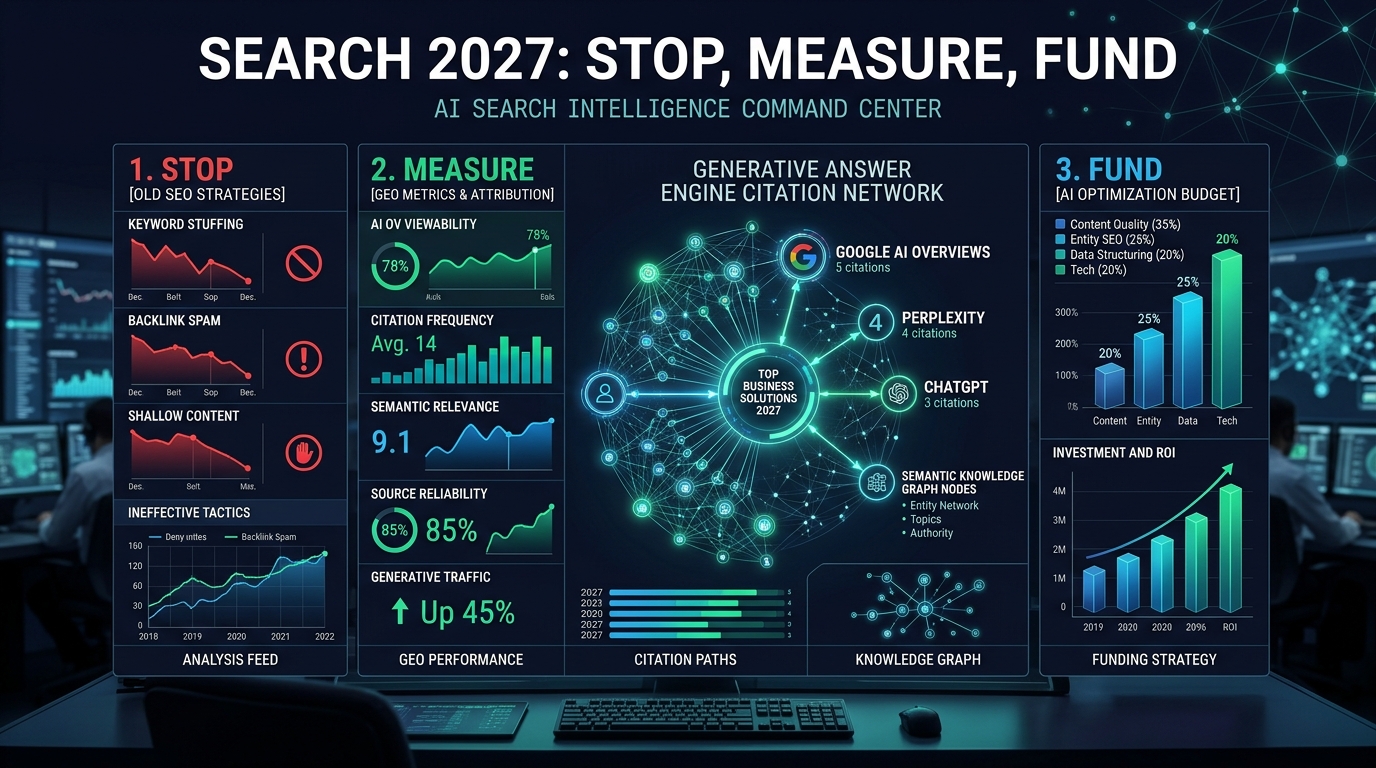
What Leaders Should Do: The Executive “Stop, Measure, and Fund” Framework
Navigating search in 2027 requires decisive strategic clarity. Marketing leaders, CMOs, and agency founders must ruthlessly audit their resource allocation according to this core three-pillar framework:
| 1. What to STOP | 2. What to MEASURE | 3. What to FUND |
|---|---|---|
|
|
|
How Juwaid KV’s GEO Framework Solves the 2027 Search Challenge
The findings from the State of Search 2027 report make one reality abundantly clear: traditional SEO agencies relying on keyword stuffing, generic directory backlinks, and surface-level blog posts cannot protect your business in the age of generative AI.
Capturing qualified organic demand today requires an integrated, high-precision methodology designed explicitly for how modern Large Language Models and hybrid search engines operate. As an experienced GEO Expert in India, Juwaid KV has developed a comprehensive Generative Engine Optimization architecture that directly addresses every tactical blind spot identified in the 2027 study.
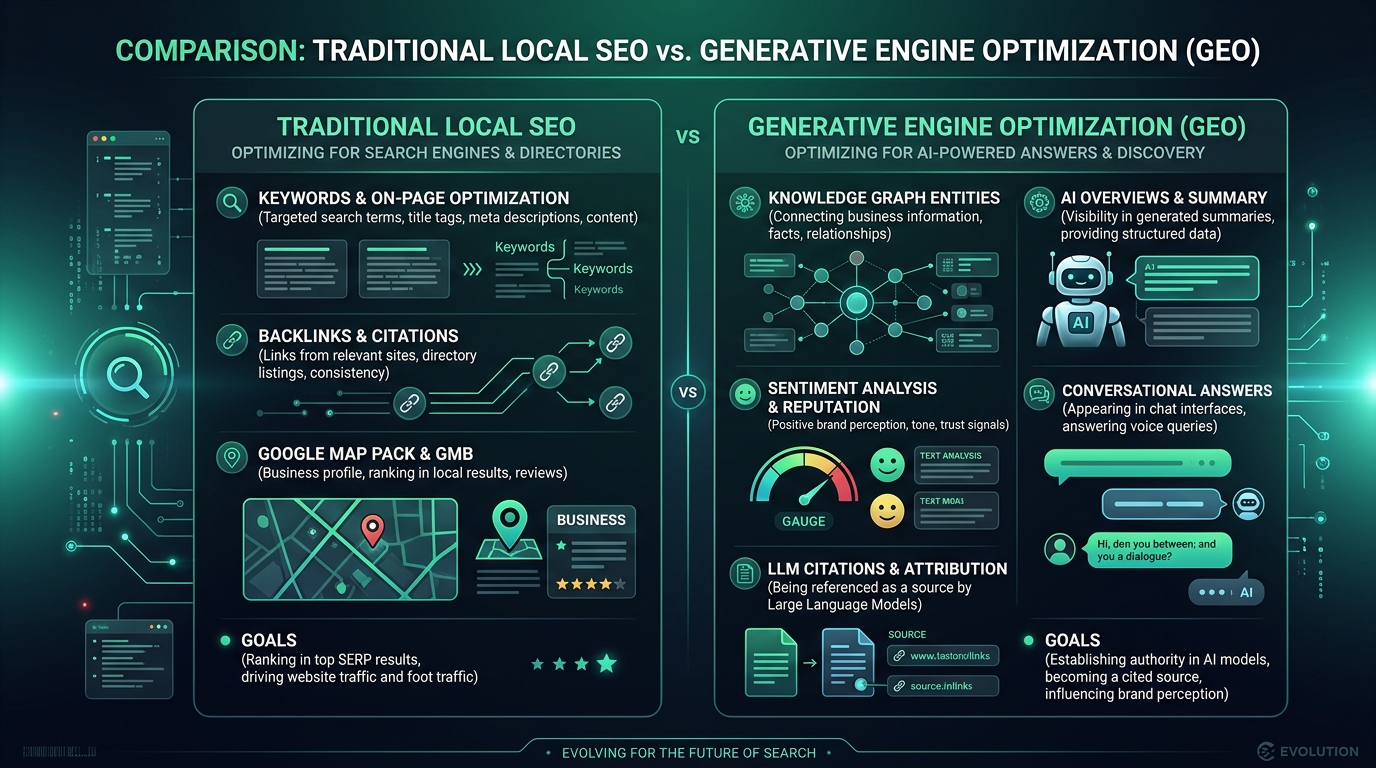
The 5 Core Pillars of Our Generative Engine Optimization Framework:
-
Entity Disambiguation & Knowledge Graph Reconciliation:
We disambiguate your brand, key executives, and proprietary offerings across Wikidata, Crunchbase, Google Knowledge Graph, and industry authority databases. By deploying nested JSON-LD schema with explicit
sameAsreconciliation, we ensure LLMs understand exactly what your enterprise does and who is qualified to deliver it. Learn more about our on-page entity optimization services. -
Bottom-Funnel Answer Engineering (Fixing the 16% Blind Spot):
Rather than wasting budget on generic top-of-funnel fluff, we engineer answer-ready comparison frameworks, transparent pricing architectures, and verified case studies formatted with the BLUF (Bottom Line Up Front) structure. When prospective clients evaluate software or services on ChatGPT Search or Perplexity, your brand is presented as the definitive recommendation.
-
Dual-Engine Technical Foundation (Protecting Crawlability):
We never make the fatal error of defunding technical health. We audit and fortify server-side rendering (SSR), optimize Core Web Vitals to sub-2-second LCP, resolve JavaScript hydration bottlenecks, and deploy standardized root
/llms.txtfiles to streamline ingestion for AI crawlers like GPTBot and ClaudeBot. Explore our technical SEO engineering services. -
Multi-Source Digital Consensus & Sentiment Optimization:
Generative models cross-reference third-party sentiment before recommending a brand. Through high-authority digital PR, contextual industry citations, and customer review sentiment optimization on Google, Trustpilot, and Clutch, we establish the algorithmic consensus required to win AI recommendations. Review our off-page authority solutions.
-
4-Layer AI Search Scorecard & Closed-Loop Revenue Attribution:
We resolve the 91% measurement void by deploying customized AI Search Scorecards. We track Prompt Share of Voice across critical buying queries, monitor citation sentiment velocity, integrate CRM pipeline tracking, and tie search investment directly to attributable closed-won revenue.
This data-backed methodology produces verified commercial results. In our published Medline Academy case study, executing this entity-driven approach generated over 2,220 organic WhatsApp admissions inquiries and delivered a 28x increase in average session duration for an educational enterprise.
Ready to Dominate AI Answer Engines & Secure Qualified Growth?
Don't let zero-click search and AI Overviews erode your commercial pipeline. Partner with India's leading Generative Engine Optimization specialist to audit your entity footprint and capture high-intent buyer citations.
Frequently Asked Questions
What is the most critical finding from the State of Search 2027 report?
The single most important finding is that search traffic is decoupling from commercial value. 39% of organizations saw organic traffic fall or stay flat while leads and conversions held steady or increased. Because Google AI Overviews and answer engines resolve low-intent informational queries directly on the search results page, visitors who continue to click through possess significantly higher commercial buying intent.
Why are 43% of organizations prioritizing Generative Engine Optimization (GEO)?
Search leaders recognize that generative AI models like ChatGPT Search, Perplexity, Google AI Overviews, and Copilot are reshaping consumer discovery. Prioritizing GEO allows brands to be directly cited, recommended, and quoted as verified authoritative solutions in synthesized answers, capturing high-intent prospects before they visit conventional blue links.
Why is defunding Technical SEO to finance GEO considered a fatal error?
AI search engines and LLM crawlers depend completely on technical web foundations to find, render, and index information. If a website suffers from JavaScript execution errors, slow Core Web Vitals, or poor crawlability, AI models cannot ingest its data. Defunding technical SEO undermines the exact foundation required for GEO visibility.
What is the 16% bottom-funnel AI search blind spot?
While 94% of organizations adopt basic GEO tactics like FAQ formatting, only 16% optimize bottom-funnel commercial content like pricing guides, competitor comparisons, and case studies. When high-intent buyers query AI assistants for purchasing advice, generative models are forced to hallucinate or cite third-party forums due to missing first-party brand data.
How can marketing leaders accurately measure AI search visibility without referral data?
Organizations should deploy a 4-layer AI Search Scorecard that monitors: (1) Prompt Share of Voice across commercial queries, (2) Citation accuracy and sentiment velocity, (3) Branded search lift and direct traffic velocity, and (4) Closed-loop CRM pipeline attribution using self-reported attribution and call tracking.
How does working with a specialized GEO Expert in India benefit global businesses?
A specialized GEO consultant engineers your digital presence for both human decision-makers and AI reasoning engines. By aligning nested JSON-LD entity schema, publishing standardized llms.txt files, creating BLUF direct answer architectures, and building cross-platform digital consensus, a GEO specialist ensures your brand is consistently recommended across all generative search platforms.
Conclusion: The Path Forward in 2027 Search
The Search Engine Journal State of Search 2027 report confirms what forward-thinking practitioners have observed firsthand: the era of relying on raw keyword volume and vanity pageviews has ended. The winners of this search transformation are not mourning lost informational clicks—they are reallocating capital into high-intent Generative Engine Optimization, protecting their technical infrastructure, and measuring business success by pipeline revenue and qualified conversions.
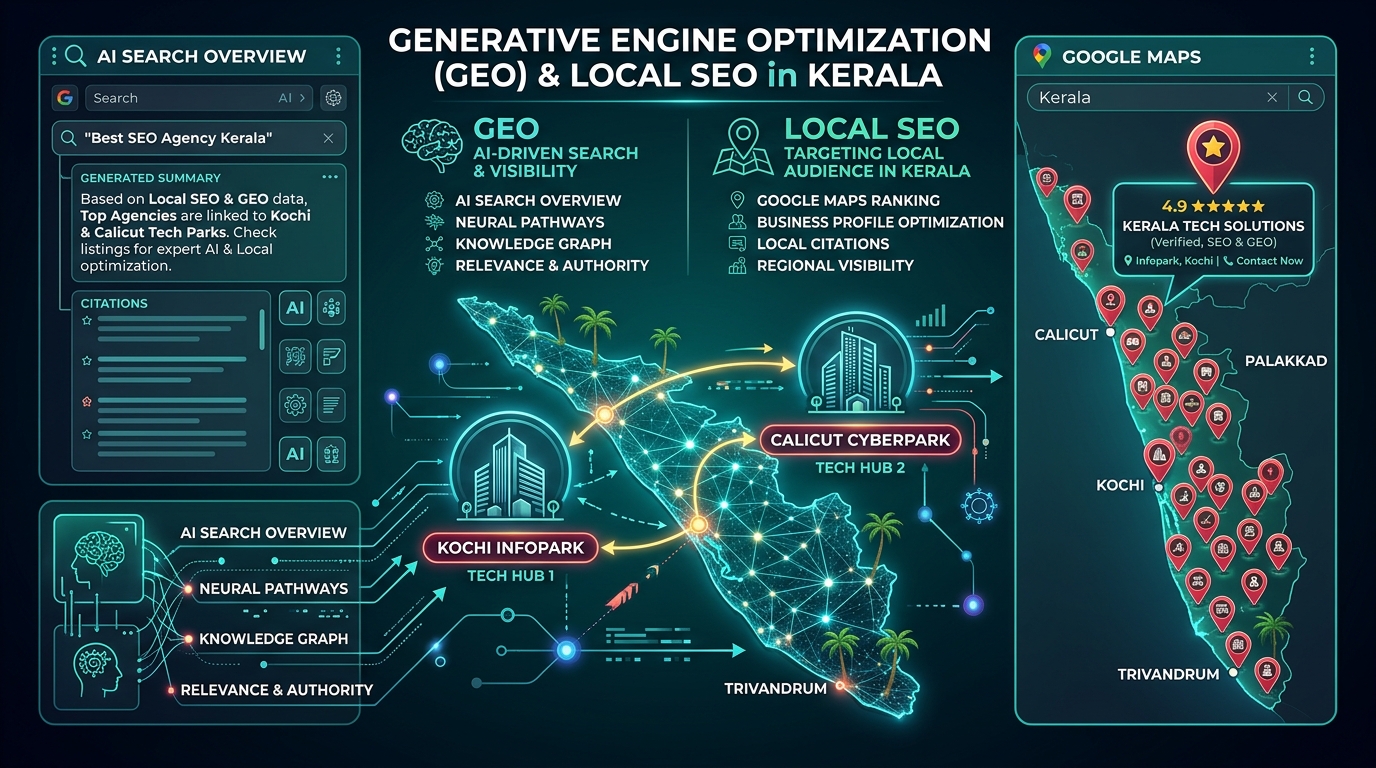
Whether your business operates across the commercial corridors of Kochi and Calicut, scales technology across Bangalore and Mumbai, or competes internationally in Dubai and the UAE, establishing authoritative AI visibility is the defining growth driver for the years ahead.
Review verified credentials on the Juwaid KV profile, study our comprehensive Generative Engine Optimization services, or contact Juwaid KV today for an executive GEO & AI search strategy audit.